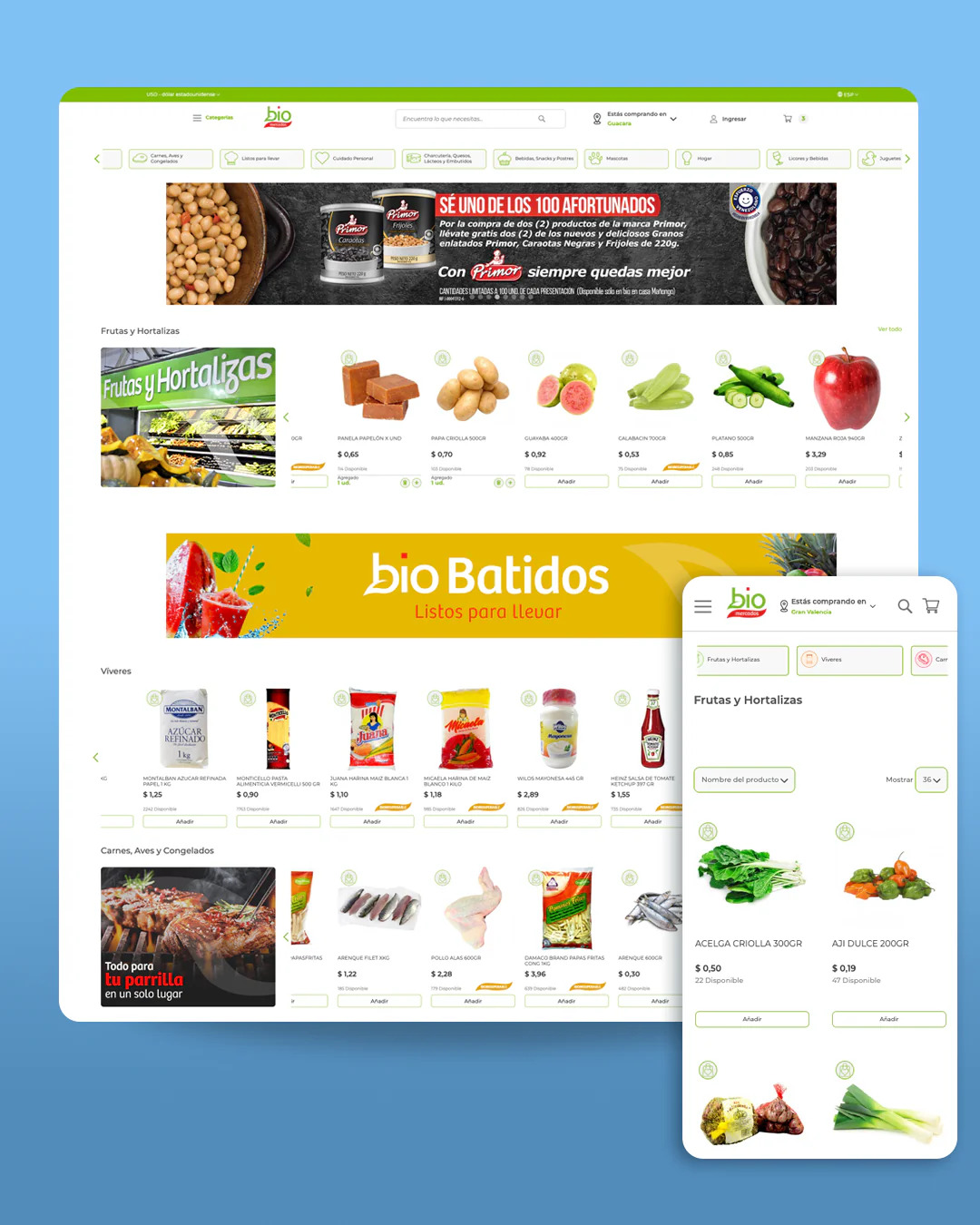
Shipping a high-scale PWA from an inherited e-commerce project
Recovered an inherited project and shipped to a high-volume customer base

TL;DR
- A Node.js + Angular e-commerce project at a regional supermarket chain had reached pre-launch with no reliable deploy path.
- I joined as the second engineer on a two-person team, finished the platform, and shipped it as a PWA + mobile apps to a high-volume customer base.
- Along the way we built the Docker image registry and CI/CD pipeline that made continuous delivery possible — for this project and the ones that followed.
Context
A regional supermarket chain in Venezuela had an e-commerce initiative in flight when I joined: there was a Node.js backend, an Angular frontend, and a customer base waiting for it. What was missing was the path from "code in a repo" to "an app customers actually use."
The shape of the work is one any engineer who has joined a pre-launch greenfield will recognise:
- A codebase that ran in development but didn't yet have a repeatable build or deploy path.
- An open question about the customer surface — PWA, native apps, or both.
- Adjacent business needs (customer segmentation, exchange-rate ingestion) waiting on someone with the bandwidth to pick them up.
The brief was simple in one sentence and hard in practice: finish it and ship it.
Constraints
| Constraint | Reality |
|---|---|
| Team size | 2 engineers total, including me, embedded with the business |
| Calendar | Months, not quarters — the chain had already waited too long |
| Stack inherited | Node.js backend, Angular frontend, no deploy story |
| Customer surface | Needed to reach customers on phones, fast, without an app-store gauntlet |
| Adjacent work | Customer segmentation and exchange-rate ingestion were also on the table |
The non-negotiable: ship something customers could use, then build the platform underneath that made the next thing easy.
Architecture at a glance
Based on the original delivery architecture (simplified from the internal diagram), this is the flow we shipped:
flowchart LR
  classDef ext fill:#e5e7eb,stroke:#6b7280,color:#282a30
  classDef svc fill:#dbeafe,stroke:#0f4c5c,color:#282a30
  classDef data fill:#d1fae5,stroke:#0f766e,color:#282a30
  classDef client fill:#fef3c7,stroke:#f59e0b,color:#282a30

  ERP[(ERP / iDempiere)]
  M2[(Magento 2)]

  subgraph Integration[Integration Layer]
    INT[Integrator]
    MS[Catalog Sync Microservice]
  end
  class INT,MS svc

  DB[(MongoDB)]

  subgraph APIs[Platform APIs]
    PROC[Process API\nCatalog, prices, tags, stock]
    APP[App API\nOrders, profile, addresses]
  end
  class PROC,APP svc

  subgraph Clients[Customer Surface]
    PWA[PWA Storefront]
    MOB[Mobile App]
  end
  class PWA,MOB client
  class ERP,M2 ext
  class DB data

  ERP --> INT
  M2 --> INT
  INT --> MS
  MS --> DB
  DB --> PROC
  PROC --> PWA
  PROC --> MOB
  PWA --> APP
  MOB --> APP
  APP --> M2
Decisions
Decision 1 — Ship a PWA first, native apps second
The fastest path to a phone screen wasn't an iOS/Android binary — it was a Progressive Web App that customers could install from a link.
| Option | Trade-off | Chose |
|---|---|---|
| Build native iOS + Android apps from day one | Months of platform-specific work; app-store review on every change | |
| Ship a PWA from the existing Angular code, wrap as mobile apps later | Web-first surface available in days, not months; one codebase to maintain |
The mobile apps came after, on the foundation the PWA had already proven.
Decision 2 — Build the deploy path before finishing the features
Tempting as it was to chase the feature backlog, the bottleneck wasn't features — it was that nothing could be deployed reliably.
| Option | Trade-off | Chose |
|---|---|---|
| Hand-deploy until launch, automate later | Faster on day one; every deploy after that costs the same hour | |
| Stand up a private Docker registry + a thin CI/CD pipeline first | Two weeks of platform work before any new feature shipped; every deploy after that was free |
Same principle as similar rescue work: stabilize the runtime before chasing the roadmap. The pipeline outlived the project — the team after me kept using it for the Node.js and Angular services that came next.
Decision 3 — Treat customer segmentation as a small, useful side-quest
Marketing wanted to know which customers to talk to and when. I ran an RFM analysis (Recency, Frequency, Monetary) on the order data the new platform was already collecting.
| Option | Trade-off | Chose |
|---|---|---|
| Wait until a dedicated data team exists | Months of waiting on insight the business needed now | |
| Run RFM on the existing data, hand the segments to marketing | Lightweight, immediately useful, and proved the new platform's data was worth something |
It wasn't a "data platform." It was a one-engineer analysis that paid for itself the first week marketing used it.
Decision 4 — Automate exchange-rate ingestion instead of typing it in
Pricing in Venezuela depends on the official exchange rate, which someone on the team was copy-pasting daily. Manual rate entry was both error-prone and beneath the pay grade of every person doing it.
| Option | Trade-off | Chose |
|---|---|---|
| Keep doing it manually | Free until it isn't — a single typo moves prices on a whole catalog | |
| Scrape the official rate on a schedule and push it into the platform | A small ingestion job; removes a daily chore and a class of pricing bugs |
This is the seed of the BCV-scraper work I later wrote about publicly. Small automations like this one tend to pay back quickly, mostly because they remove a recurring human failure mode rather than because they save time directly.
Outcome
By the end of the engagement:
- The platform shipped as a PWA + mobile apps used by a high-volume customer base.
- The company had a private Docker registry and a working CI/CD pipeline for Node.js and Angular services — the foundation for everything that came after.
- Marketing had RFM-based customer segments they could act on, drawn from the platform's own data.
- Pricing ran on an automated exchange-rate feed instead of a daily copy-paste.
In hindsight, the sequencing mattered more than the headcount: getting the deploy path in place before chasing the feature backlog is what made the rest of it shippable by a small team.
What I'd do on GCP today
Same brief today, same team size, same constraints. The instincts wouldn't change; the targets would.
- Frontend: ship the PWA the same way, but host it on Firebase Hosting or Cloudflare Pages with a CDN edge in front. Lighthouse perf as a CI gate, not an afterthought.
- Backend: containerize the Node.js services for Cloud Run. No private registry to maintain — Artifact Registry comes with the platform.
- CI/CD: GitHub Actions → Cloud Run, preview environment per PR. The pipeline I hand-built in 2022 is now ten lines of YAML.
- RFM and segmentation: land the orders in BigQuery via a Cloud Run job, run the RFM query as a scheduled view, and surface the segments to marketing through Looker Studio instead of a CSV. Same analysis, no engineer in the loop after week one.
- Exchange-rate ingestion: Cloud Scheduler → Cloud Run job → Pub/Sub → BigQuery + the storefront cache. The scraper still runs; everything around it stops being a cron on a single VM.
- Mobile apps: Capacitor or PWABuilder wrapping the same PWA, signed and shipped through Firebase App Distribution for staged rollouts.
The shape of the work stays the same — deploy path first, customer surface next, the smaller automations after that. GCP just removes a lot of the platform plumbing that used to be the job.
If you're working through something similar and want a second pair of eyes, I'm happy to talk it through — reach out here.
The Intern is downloading movies again
What happens when you give tech-savvy people eight hours of internet access a day? Welcome to the The Intern is downloading movies again problem.
Jhey Pi: an official landing site for an aspiring musician
Official landing site for Jhey Pi, built with Nuxt 4 and Nuxt UI to combine Spotify releases and YouTube videos into a single feed.